
PRECIPITATION & DROUGHT
Rainfall is not simply becoming less. It is becoming more uneven.
Bulgaria lies in a transition zone between continental and Mediterranean climate influences. This makes precipitation highly variable across both space and time — and increases the country’s vulnerability to drought.
SCROLL TO EXPLORE ↓
01 / A HIGHLY VARIABLE CLIMATE
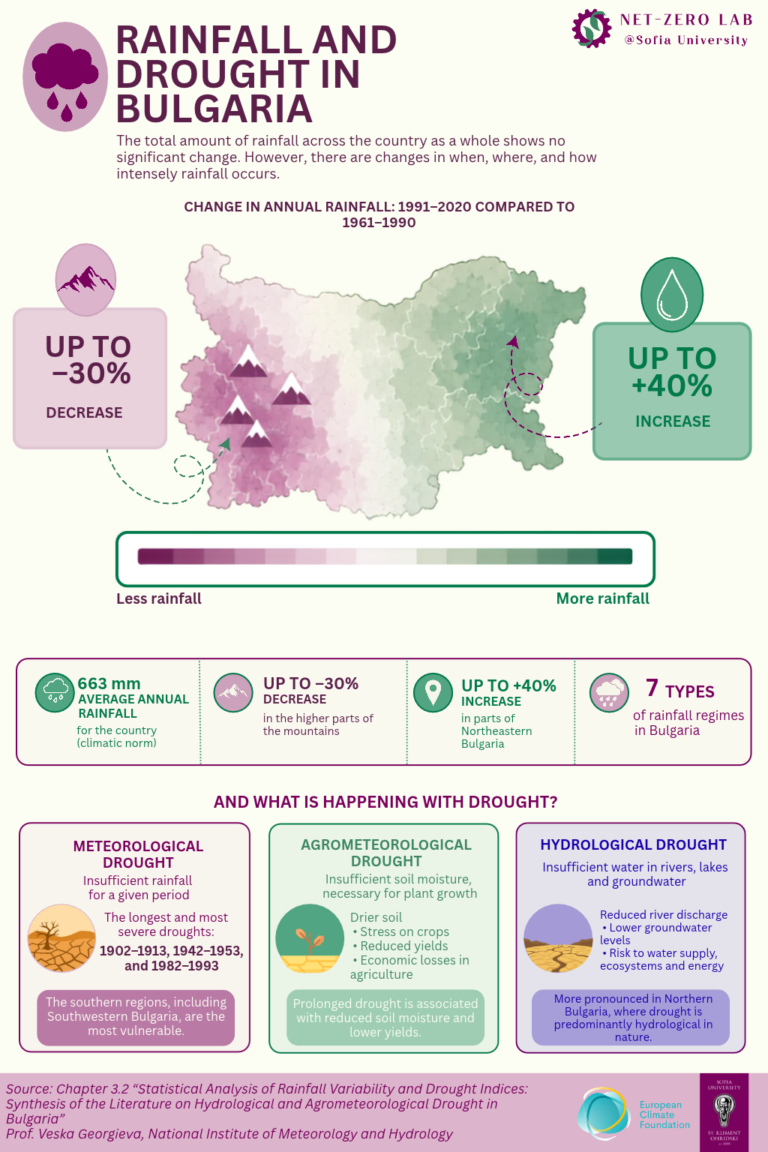
Bulgaria receives an average of 663 mm of precipitation each year.
That national average, however, hides substantial regional differences in when and where precipitation falls.
663 mm
Average annual precipitation for Bulgaria.
02 / TWO DIFFERENT RAINFALL PATTERNS
The season of rainfall depends strongly on where you are.
In the temperate-continental part of Bulgaria, rainfall is relatively evenly distributed through the year, with a modest summer maximum. In continental-Mediterranean regions, the seasonal pattern is almost reversed.
The regions receiving the least summer rainfall are also exposed during the growing season, when crops need water most.
03 / SEVEN PRECIPITATION REGIMES
One national average. Seven distinct regional rainfall regimes.
Regionalisation of precipitation reveals how strongly rainfall patterns differ across Bulgaria. These differences are particularly important for basin-level water management and climate adaptation.
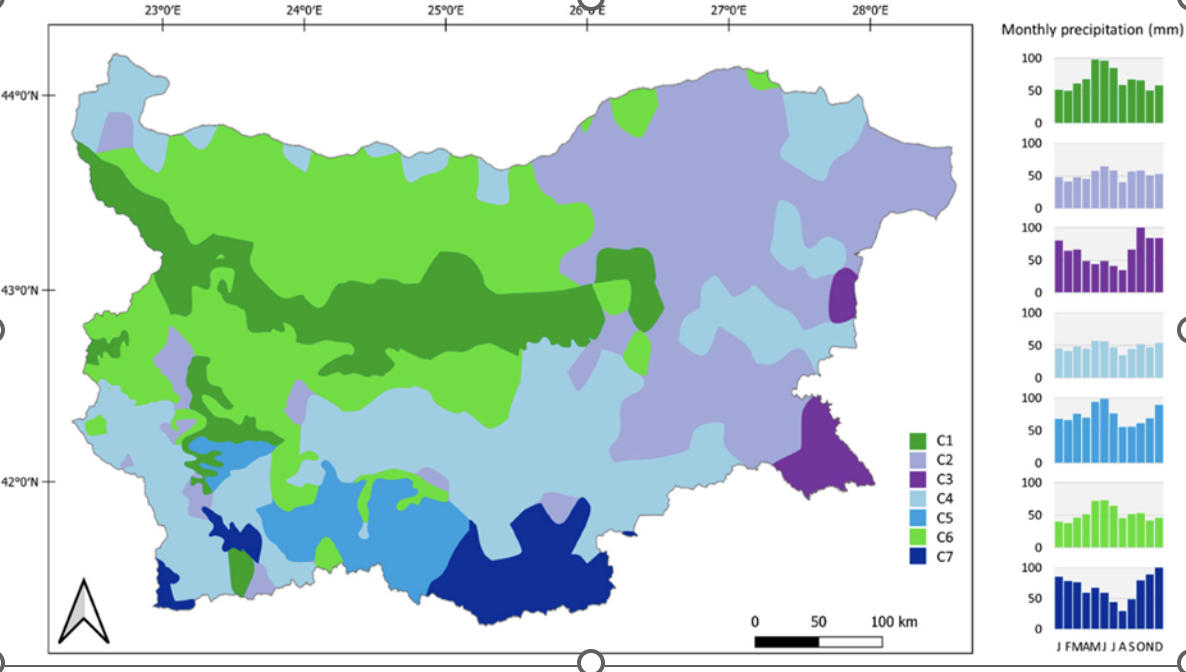
Source: Malcheva, K., Neykov, N., Bocheva, L., Stoycheva, A., & Neykova, N. (2026). Analysis of Precipitation and Regionalization of Torrential Rainfall in Bulgaria.
04 / CHANGE IS REGIONAL
National rainfall totals have changed little. Regional rainfall has not.
Comparing 1961–1990 with 1991–2020 shows no significant change in annual precipitation for Bulgaria as a whole because increases and decreases in different regions offset one another.
05 / INTENSITY MATTERS
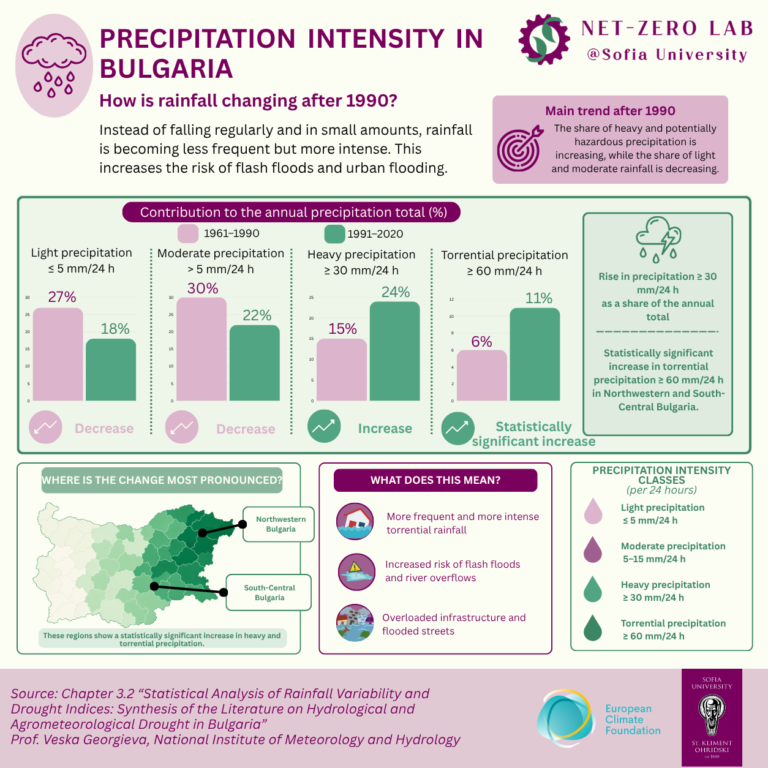
The important change is not only how much rain falls — but how intensely it falls.
Since 1990, strong and potentially hazardous precipitation has contributed more to annual rainfall, while the contribution from weak and moderate rainfall has declined.
≥ 30 mm / 24 h
Threshold used in the assessment for strong, potentially hazardous daily precipitation.
Statistically confirmed evidence shows that hazardous-intensity rainfall has already become significantly more frequent in Northeastern Bulgaria and Central Southern Bulgaria.
06 / DROUGHT IS NOT JUST A LACK OF RAIN
Drought can develop in every season — and it can take different forms.
Bulgaria lies in a zone of insufficient moisture. Droughts of different duration, intensity and spatial extent are characteristic of every season.
Prolonged precipitation deficit.
Insufficient soil moisture for vegetation and crops.
Reduced water availability in rivers, reservoirs and other water resources.
07 / THE LONG DROUGHT RECORD
Bulgaria’s drought history contains several prolonged dry periods.
Analyses using multiple drought indices identify three periods with particularly prolonged and severe drought conditions.
1945 · 1993 · 2000 · 2007
Among the driest years identified on both an annual basis and for the May–September growing season.
08 / MEASURING DROUGHT
No single index tells the whole drought story.
Different indicators capture different parts of the drought process. Combining several indices is considered the most reliable approach.
Useful for practical drought monitoring, but does not account for temperature.
Adds potential evapotranspiration and therefore provides a broader picture under warming conditions.
Uses measured or modelled soil moisture to identify the onset of soil drought.
09 / DROUGHT HAS A GEOGRAPHY
The character of drought changes across Bulgaria.
Regional studies reveal a clear spatial differentiation in drought frequency, intensity and impact.
Southern regions, including Southwestern Bulgaria, experience stronger drought pressure associated with greater Mediterranean influence.
In Northern Bulgaria, particularly the Danube Plain, drought is more strongly associated with reductions in available water resources.
10 / THE BIGGER PICTURE
More variability. More extremes. More pressure on water.
Bulgaria’s precipitation and drought patterns are defined by high variability and strong regional differences. Changes in rainfall intensity and the increasing frequency of drought highlight the need for integrated monitoring, water management and adaptation.
Chapter author: Prof. Veska Georgieva, National Institute of Meteorology and Hydrology (NIMH)
 English
 Bulgarian