
CLIMATE CHANGE IN BULGARIA
Air Temperature and Extreme Temperature Events in Bulgaria
Trends and future changes in Bulgaria’s air temperature and extreme temperature events.
SCROLL TO EXPLORE ↓
01 / A WARMING CLIMATE
Temperature rise is one of the clearest signals of climate change.
Over recent decades, the frequency and intensity of extreme temperature events have increased. Bulgaria is experiencing more intensive warming and a higher frequency of extreme events than the global average. Its geographical position and diverse relief also create substantial regional differences in temperature patterns.
This warming is increasingly accompanied by heat waves, tropical nights and extremely high temperatures.
02 / OBSERVED TEMPERATURE TRENDS · 1991–2025
Bulgaria has warmed significantly, particularly since the beginning of the 21st century.
+0.8°C
Average annual temperature in Bulgaria during 1991–2020 compared with the 1961–1990 baseline.
Mean monthly minimum temperatures increased by approximately 0.4–1.7°C between the two periods. This change has been accompanied by a narrowing of the daily temperature range and an increase in tropical nights.
Warming is strongest in Northern Bulgaria and during summer. Changes are weaker in mountain regions. Spring also shows a clear temperature increase, while autumn shows the smallest changes.
03 / RECENT WARMING
The most recent years make the trend increasingly visible.
2024
According to the National Institute of Meteorology and Hydrology, 2024 was among the warmest years recorded in Bulgaria.
During 2023–2025, many regions experienced prolonged periods of heat with temperatures above 35°C. Summers are becoming hotter, while winters are becoming milder and shorter.
04 / EXTREME TEMPERATURE EVENTS
Heat waves are becoming more frequent, longer and more intense.
Climate models show an increase in the frequency and intensity of European heat waves at warming levels above 1.5°C. In Southern Europe, including Bulgaria, heat waves are among the most prominent manifestations of climate change.
The increase is particularly clear in the Upper Thracian Plain and the Struma Valley. The summers of 2007, 2012, 2021, 2023 and 2025 stand out as exceptionally hot, creating risks for human health and infrastructure.
05 / TROPICAL NIGHTS
Increasingly, the heat does not disappear after sunset.
20°C
A tropical night occurs when the minimum night-time temperature does not fall below 20°C — an indication that there is little or no night-time cooling.
The frequency of tropical nights has clearly increased since 2000, especially in Bulgarian cities and lowland areas. The urban heat-island effect further raises night-time temperatures in major cities.
06 / THE OTHER SIDE OF WARMING
Cold extremes are declining as the frost-free season becomes longer.
Ice days and frost days are decreasing in almost all regions of Bulgaria. At the same time, the frost-free period is becoming longer, driven in part by the earlier occurrence of the last spring frosts.
07 / COMPOUND AND CASCADING EVENTS
Heat does not act alone.
Modern climate research increasingly focuses on compound and cascading events. Bulgaria frequently experiences heat waves and droughts followed by intense rainfall and flooding.
Prolonged hot periods increase wildfire risk, while sudden rainfall over dry soils increases the risk of erosion and flooding.
08 / FUTURE CLIMATE CHANGE
The +2°C threshold for Southeast Europe could be exceeded within the coming decades.
Research indicates that the Paris Agreement threshold of +2°C for Southeast Europe will be exceeded in the coming decades. In the near term, projections show only a weak dependence on the different emissions scenarios.
At the same time, the frequency of cold days and nights is projected to decline by approximately 6–10 days.
09 / A CLIMATE MOVING SOUTH
Bulgaria’s future climate could feel several hundred kilometres farther south.
Today, mean annual temperatures in Bulgaria’s lowlands range between approximately 10.6°C and 13.3°C. Under the more intensive warming scenario, the average temperature for the whole country would exceed values that are currently exceptional and limited to the warmest southern areas.
Southern Greece
In practical terms, the climate of the whole country could shift southward by several hundred kilometres compared with how it feels today — with summers resembling those currently experienced in Southern Greece.
10 / FIGURE 01 · 1950–2100
Mean air temperature in Bulgaria under two future climate pathways.
The historical part of the series shows the observed warming. After the present day, the projections diverge between the moderate RCP4.5 pathway and the more intensive RCP8.5 pathway.
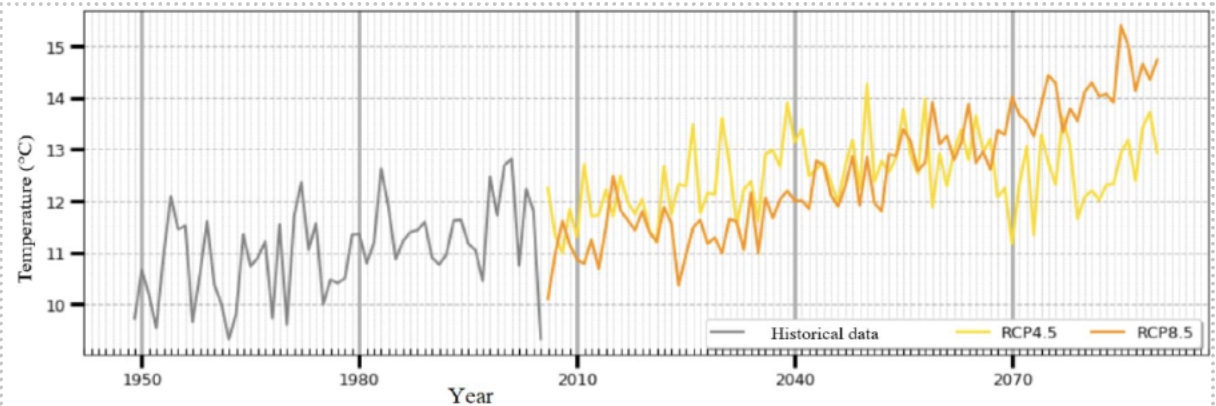
≈ 1.3°C
Approximate difference in annual mean temperature between the two scenarios by the end of the century. See the Methodology chapter for more information about the scenarios.
Chapter author: Nina Nikolova, Faculty of Geology and Geography, Sofia University “St. Kliment Ohridski”
 English
 Bulgarian