
CLIMATE SCIENCE IN BULGARIA
Mapping Climate Science in Bulgaria
A bibliometric analysis of 106 peer-reviewed publications indexed in Scopus reveals how climate research in Bulgaria has evolved between 2015 and 2025.
SCROLL TO EXPLORE ↓
01 / A DECADE OF RESEARCH
Climate research in Bulgaria is expanding.
106
peer-reviewed publications indexed in Scopus between 2015 and 2025
The evidence points to growing scientific activity, a broader thematic scope and increasing interdisciplinarity. The Bulgarian Academy of Sciences provides much of the country’s core capacity for observing, analysing and modelling climate processes.
02 / HOW KNOWLEDGE IS PUBLISHED
How is climate research published?
The publication structure helps reveal how Bulgarian climate knowledge reaches the scientific community — and how visible and citable that research can become internationally.
FIGURE 01
Publication Types
Distribution of Bulgarian climate-change publications by type of scientific output, 2015–2025.
03 / THE RESEARCH ECOSYSTEM
Who is driving climate research in Bulgaria?
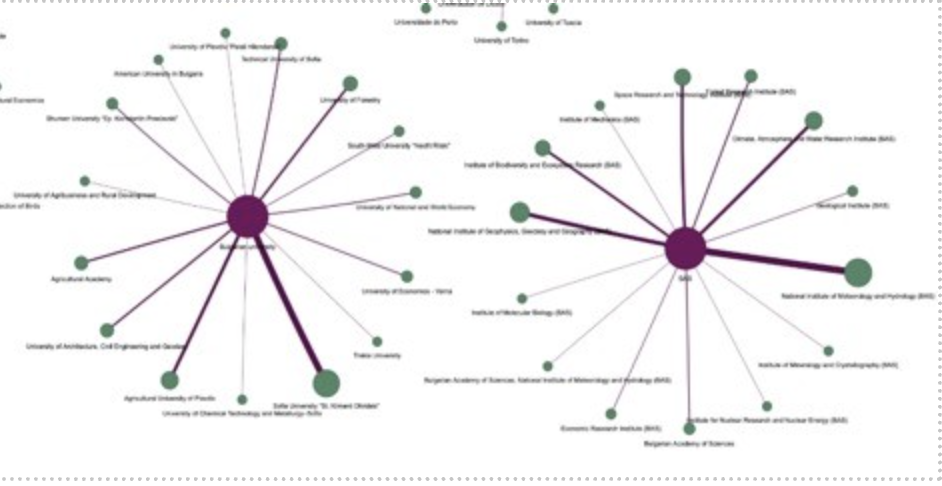
The Bulgarian Academy of Sciences plays a leading role, alongside Sofia University, the Agricultural University – Plovdiv, UACEG, UNWE and regional academic units. International partnerships connect this ecosystem with European research institutions and comparative climate studies.
FIGURE 02
Institutional Research Network
Structural map of institutions contributing to climate-change research in Bulgaria, 2015–2025.
04 / WHAT SCIENCE IS LOOKING AT
What does Bulgarian climate science focus on?
+0.8°C
Average annual temperature in Bulgaria for 1991–2020 compared with the 1961–1990 baseline.
Research spans climate and atmospheric dynamics, snow cover and the cryosphere, hydrology, agriculture, forest ecosystems and the carbon cycle, as well as urban climatology and the urban heat-island effect.
05 / UNEVEN COVERAGE
Research is not evenly distributed.
Hydrology and climate dynamics receive substantially more scientific attention than sector-specific and socio-economic dimensions of climate change.
FIGURE 03
Publications by Thematic Area
Number of scientific publications across the main thematic areas of climate change in Bulgaria.
06 / FUNDING THE SCIENCE
Who funds climate research?
Research is funded primarily through national public sources and European programmes, often through mixed funding models. Corporate funding of climate research is practically absent.
FIGURE 04
Funding Network
Most frequently cited funding organisations and programmes across the analysed scientific publications.
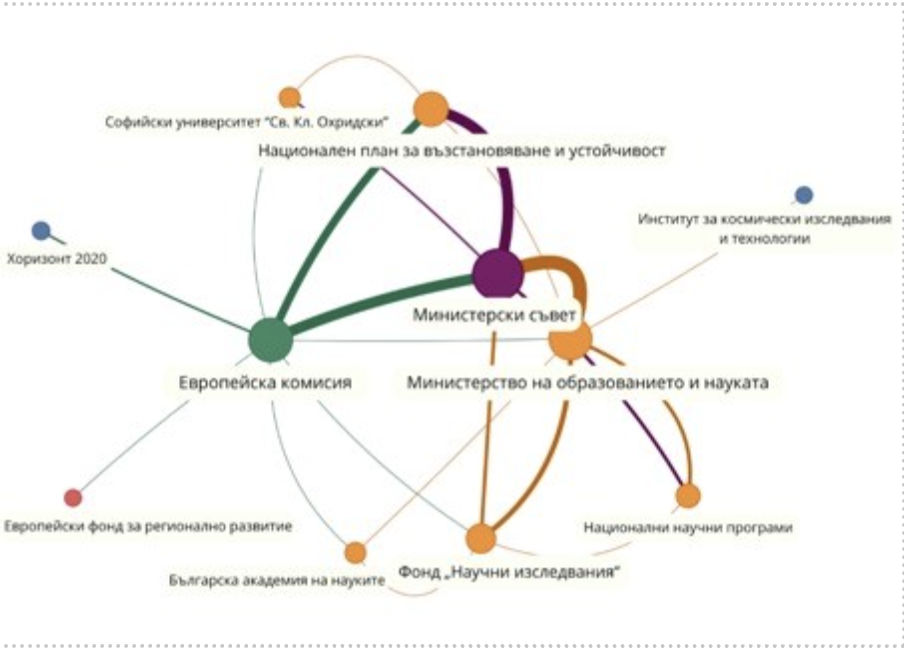
National Science Fund · Horizon 2020 · Erasmus+ · ERDF · ESF+ · Recovery and Resilience Facility
07 / WHAT IS STILL MISSING
The research gaps are as important as the findings.
01
Coastal & Marine Systems
Sea-level rise, coastal erosion and climate impacts on tourism remain weakly studied.
02
Energy
The resilience of energy infrastructure and the reliability of renewable energy under extreme temperatures are addressed only fragmentarily.
03
Health
Heat-related mortality and vector-borne diseases are not yet covered through systematic analysis.
04
Socio-economic Impacts
Climate migration, energy poverty and household adaptation remain almost unexplored.
08 / THE BIGGER PICTURE
We know more about what climate change does to nature than what it does to society.
Bulgarian climate science currently describes impacts on natural systems far more extensively than the transformation of social, economic and infrastructure systems.
 English
 Bulgarian