
FOREST FIRES
Forest fires are becoming an increasingly important environmental and climate risk for Bulgaria.
Forest fires are among the country’s most significant natural hazards in both frequency and environmental impact. Their consequences extend beyond burned land — affecting ecosystems, air quality, communities and the carbon balance of forests.
SCROLL TO EXPLORE ↓
01 / WHY FIRES START
A forest fire rarely has a single cause.
Fire risk emerges from the interaction of atmospheric conditions, climate, available fuel and terrain.
Lightning, high temperatures, low humidity and strong winds.
Lower precipitation and rising average temperatures.
Large quantities of dry plant material increase available fuel.
Accumulated woody material can intensify combustion.
Mountainous areas and slopes influence fire behaviour and spread.
02 / THE HUMAN FACTOR
Human activity is another major source of ignition.
Anthropogenic causes include negligence, deliberate ignition, economic activity, transport and electrical failures.
03 / IMPACTS CASCADE
The consequences continue long after the flames are gone.
Forest fires can affect water, air, ecosystems, communities and long-term drought conditions.
Burned landscapes can become more vulnerable to runoff and erosion.
Smoke and combustion products degrade air quality.
Fires threaten settlements, health and safety.
Habitats and forest resources can be lost or severely damaged.
Long-term ecosystem changes can reinforce drying processes.
04 / SURFACE VS CROWN FIRES
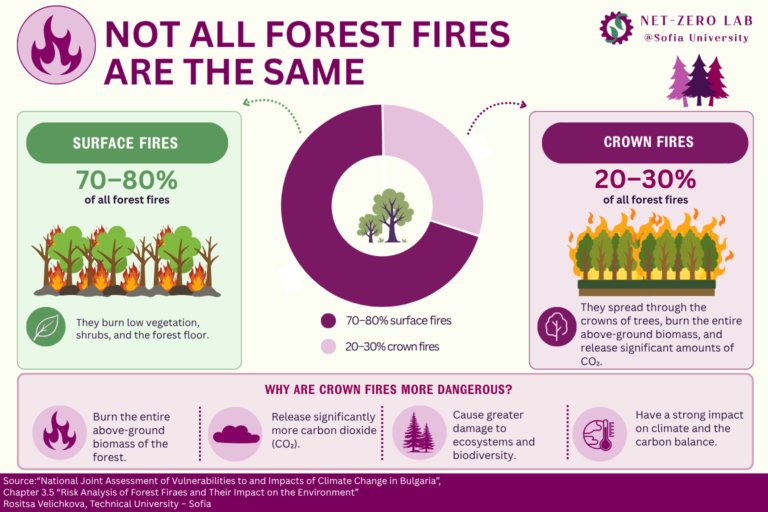
Most forest fires remain close to the ground — but the rarer crown fires cause the greatest damage.
In the temperate climate zone, including Bulgaria, approximately 70–80% of forest fires are surface fires, while around 20–30% develop into crown fires.
the more frequent fire type
rarer, but capable of burning the entire above-ground biomass
Crown fires release large amounts of heat energy and carbon dioxide because the whole above-ground biomass is involved.
05 / FIRE ACTIVITY · 1980–2025
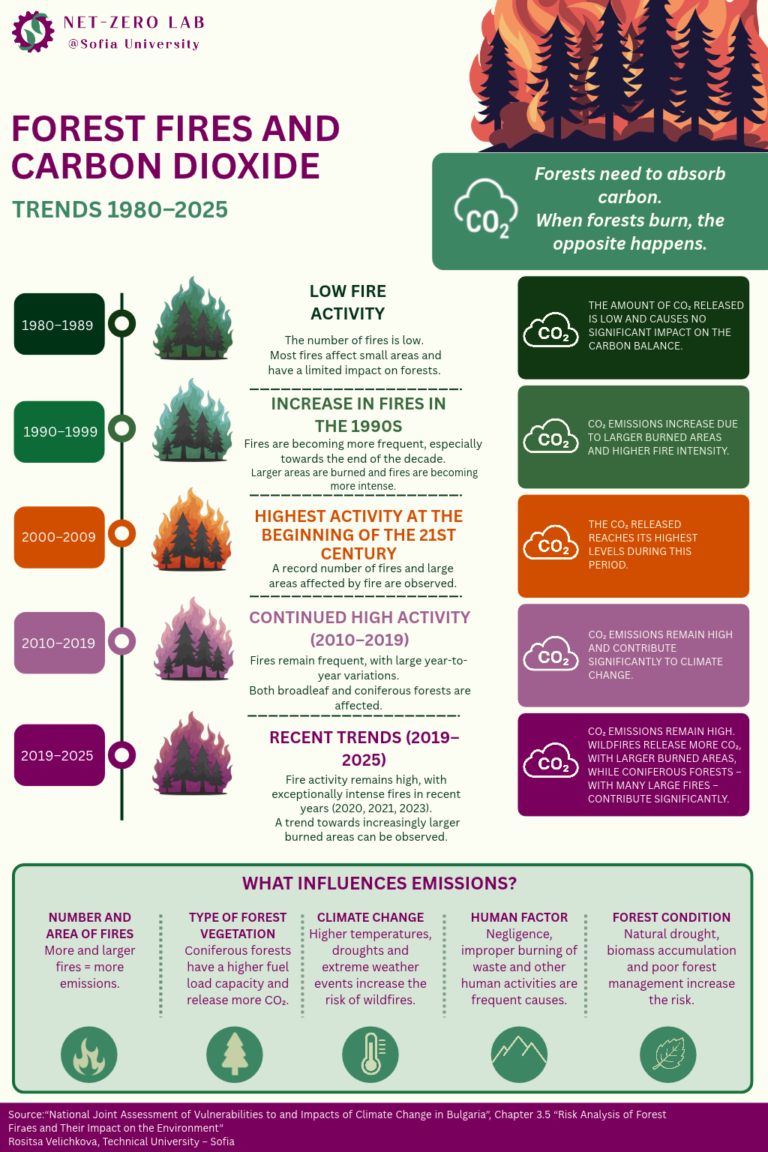
The long-term record points to increasing fire activity.
The annual number of registered fires in Bulgaria shows pronounced peaks in the driest and hottest years, alongside an overall tendency toward higher fire activity in recent decades.
Annual number of registered fires in Bulgaria.
Source: author calculations based on data from the General Directorate Fire Safety and Civil Protection and the European Forest Fire Information System (EFFIS).
06 / FIRE → CARBON
A forest fire is also a carbon event.
The assessment calculates carbon dioxide emissions for 2019–2025 separately for burned coniferous and deciduous forest areas.
07 / CONIFEROUS FORESTS
Coniferous forests generally have greater potential for CO₂ release during fire.
The difference is associated with higher calorific value and a larger quantity of combustible material.
Annual carbon dioxide emissions released from coniferous forests.
Source: author calculations based on burned coniferous forest areas for 2019–2025.
08 / DECIDUOUS FORESTS
Deciduous forests show greater variation from one fire year to another.
Their emissions depend more strongly on the area affected by fire. Large burned areas can therefore still produce very high carbon emissions.
More fuel mass and higher calorific value can increase CO₂ release.
Emissions depend more strongly on the size of the burned area.
09 / THE RELATIONSHIP IS NOT LINEAR
More fires do not automatically mean proportionally more carbon.
The number of fires matters, but emissions are also controlled by burned area, fire intensity and the type of forest vegetation.
10 / THE BIGGER PICTURE
Forest fires are increasingly connected to Bulgaria’s carbon balance.
The results indicate a tendency toward greater fire activity and higher carbon emissions in recent years. This strengthens the environmental importance of forest fires and their role in climate-change processes.
Together, these determine ecosystem damage and the scale of carbon released back into the atmosphere.
Chapter author: Prof. Dr. Eng. Rositsa Velichkova, Technical University of Sofia.
 English
  Bulgarian