
An electricity system can be planned remarkably far in advance. Generators schedule their output, consumers’ expected demand is forecast, electricity is traded across borders and market participants establish positions hours or even days before the electricity is actually delivered.
But the grid does not operate according to those plans. This summer, the gap between planning and reality has become unusually visible. Record-low water levels in the Danube have forced Romania to shut down both reactors at Cernavodă, temporarily leaving the country without nuclear generation, and have severely constrained output at Hungary’s Paks nuclear plant. At the same time, extreme heat has increased electricity demand for cooling across Europe. Strong solar generation can provide an important countervailing effect during daylight hours, depressing wholesale prices when supply is abundant, but this does not eliminate the system’s need for flexibility, particularly as solar output falls in the evening while demand remains elevated.
Meanwhile, the grid cannot simply wait for the market to catch up to equilibrium again and meet demand with supply. Electricity generation and consumption have to remain in balance continuously to maintain the physical stability of the power system. When they diverge, system frequency begins to change, triggering automatic responses and, when necessary, action by the transmission system operator (TSO). Flexible generators can increase or reduce their output; storage solutions can charge or discharge; consumers can adjust their consumption.
Thus, balancing becomes ultimately a physical necessity. But it simultaneously has an economic dimension: flexibility has a price. System operators need to procure resources that can respond when needed, and they need to pay for the balancing energy that is actually activated, whether in the upward or downward direction. The resulting costs depend on how much flexibility is available, how much is needed, and how quickly the system has to respond.
The same physical requirement – to keep generation and consumption in balance – can result in very different balancing prices and activated volumes across countries. A market may have relatively high prices because flexible resources are scarce, while another may activate much larger volumes at lower prices. High prices and high volumes, in other words, tell different stories about a power system and neither is sufficient on its own to measure the cost of balancing.
There is also no single “balancing price”. Markets distinguish between the price paid for keeping balancing capacity available, the price of balancing energy when resources are actually activated, and the imbalance price used to financially settle deviations between market participants’ positions and their actual allocated generation or consumption.
What do Bulgaria’s balancing-market data tell us about balancing costs and flexibility?
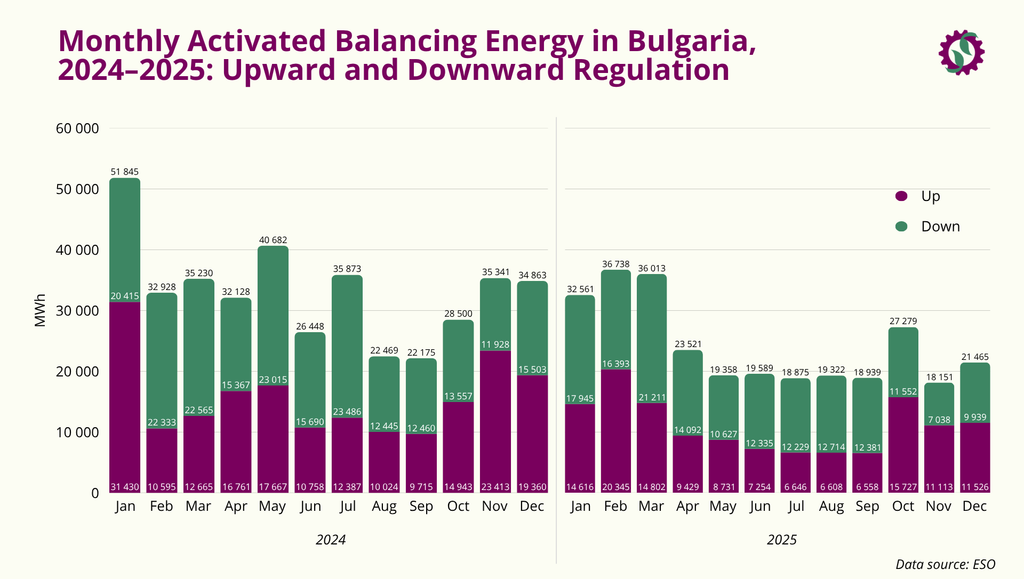
In Bulgaria, the Electricity System Operator (ESO) is responsible for maintaining the balance of the electricity system and publishes detailed balancing-market data. Between 2024 and 2025 the data shows that there is a substantial reduction in the volume of activated balancing energy. In 2024, ESO activated approximately 398 GWh of balancing energy, consisting of around 190 GWh of upward regulation and 209 GWh of downward regulation. In 2025, total activation declined by approximately 27%, to around 292 GWh, comprising approximately 133 GWh of upward and 158 GWh of downward regulation. Thus, the reduction was observed in both directions, although downward activation remained somewhat larger than upward activation in both years. The decline in total activation indicates that less balancing energy was activated by the TSO, although the volume figures alone cannot establish whether this reflects improved forecasting, changes in market participants’ behaviour, changes in system conditions, developments in balancing-market design, or a combination of these factors. There was also a modest change in the seasonal distribution of activation. January was the month with the highest overall activation in 2024, whereas the peak shifted to February in 2025.
Figure 1: Upward and Downward Balancing Energy Activated by ESO, 2024–2025
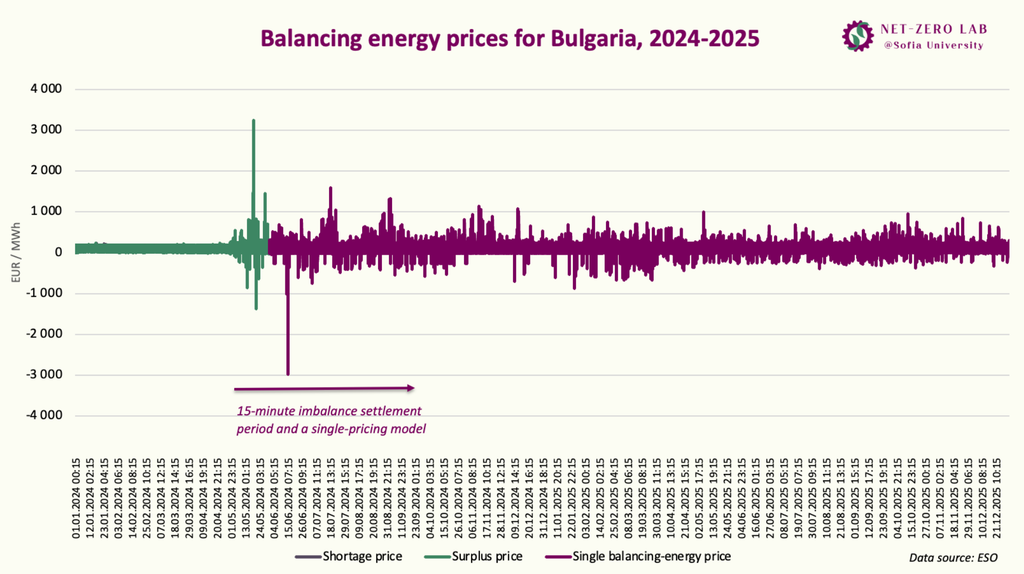
The price data reveal a much more pronounced change. During the first four months of 2024, balancing-energy prices generally remained within a comparatively moderate range, with prices generally ranging between approximately 0-260 EUR/MWh. From May 2024 onwards, however, the price distribution became considerably more volatile, including both exceptionally high positive and very large negative prices. This change is particularly visible in the extreme events recorded during May and June 2024. The most notable episode occurred on 19 May 2024, when the balancing market generated an extraordinary financial surplus for ESO. According to ESO, the surplus amounted to 13 million EUR1 and resulted from a combination of inaccurate forecasting, delayed decisions by market participants to achieve balanced schedules, and an underestimation of the system situation by a significant proportion of balancing-group coordinators. The scale of the event is also evident in the underlying balancing-energy prices: the surplus price exceeded 3,200 EUR/MWh, while an exceptionally low shortage price was recorded on 15 June 2024, reaching almost −3,000 EUR/MWh.
The developments in 2024 should, however, be viewed against the background of a significant change in Bulgaria’s imbalance-settlement framework. From May 2024, Bulgaria moved to a 15-minute imbalance settlement period and a single-pricing model2. The subsequent data indicate a gradual moderation of the extreme price movements. Nevertheless, prices remained considerably more volatile than during the first four months of 2024. When the data are considered at the monthly level, the highest average monthly balancing-energy price over the 2024–2025 period was recorded in November 2024, at approximately 161 EUR/MWh. In 2025, the highest monthly average was observed in October 2025, at approximately 143 EUR/MWh. In both years, prices generally tended to be lower during the summer months.
Figure 2: Balancing energy price fluctuations, 2024-2025
The fluctuation in balancing prices highlights the growing importance of flexibility resources in Bulgaria, particularly as the system absorbs increasing amounts of variable renewable generation. Currently Bulgaria is rapidly expanding battery storage. According to the European Commission’s 2026 Country Report, contracts have been signed for 1,120 MW of co-located battery storage and close to 14,000 MWh of grid-scale battery energy storage. In addition, around 14.7 GWh of battery storage is already operational, with total capacity expected to reach approximately 21 GWh by the following months3. These assets can shift electricity across time – charging during periods of renewable oversupply and discharging when the system is short – thereby providing a potentially important source of balancing flexibility.
Demand-side flexibility, however, remains largely undeveloped in the country. The European Commission reports that smart-meter penetration is below 5% and that regulated household retail tariffs remain largely disconnected from wholesale price signals. Together, these conditions limit both consumers’ ability and their incentive to adjust consumption in response to system conditions. Bulgaria’s flexibility framework therefore remains heavily supply-side oriented. Batteries can respond to system needs, but demand response can provide a complementary source of flexibility from the other side of the market: reducing consumption during periods of shortage and increasing it when electricity is in surplus.4
While developing domestic flexibility is essential, national power systems do not operate in isolation. A key pillar of the European Union’s energy strategy is the cross-border integration of electricity balancing markets, which allows TSOs to access balancing resources beyond their national borders, thus potentially reducing overall balancing costs and improving system security. Two EU balancing platforms are particularly relevant:
- PICASSO – for automatic Frequency Restoration Reserves (aFRR);
- MARI – for manually activated Frequency Restoration Reserves (mFRR).
Bulgaria joined PICASSO in February 2025, followed by Greece in March. But cross-border exchange of aFRR balancing energy between the two systems began in April 2025. In principle, PICASSO creates a common merit-order process for aFRR balancing-energy offers, allowing balancing energy to be activated across borders where technically and commercially feasible, subject to available transmission capacity. The integration of Bulgaria and Greece therefore means that, subject to the relevant network and capacity conditions, balancing resources in either system can provide access to balancing flexibility across their shared border.
Looking at recent weekly data on balancing-market conditions in Bulgaria and Greece (20–26 July 2026), published by ESO and IPTO, the two systems recorded relatively similar average imbalance-settlement prices despite very different levels of balancing activation. Bulgaria’s average imbalance-settlement price was 74.77 EUR/MWh, compared with 80.67 EUR/MWh in Greece – a difference of only around 8%. Yet balancing activation intensity was approximately 1% of load in Bulgaria, compared with 20% in Greece. And this is an example of how one system can activate large volumes of balancing energy without necessarily producing proportionally higher imbalance prices, depending on the availability and cost of flexible resources. The direction of activation also differed markedly. In Bulgaria, downward activation accounted for around 80% of the total, compared with 50% in Greece. Bulgaria’s net activation was therefore strongly downward, while Greece’s upward and downward volumes were almost balanced. During this particular week, the Bulgarian system was consequently much more frequently in a position where the TSO needed to reduce net generation or increase consumption, whereas Greece required a more balanced mix of upward and downward regulation.
Table 1: Balancing energy activation by direction and relative to load, Bulgaria and Greece, 20–26 July 2026
| Bulgaria | Greece | |
| Up | 1 204 MWh | 120 586 MWh |
| Down | 5 596 MWh | 116 292 MWh |
| Total activated | 6 800 MWh | 236 878 MWh |
| Up share | 18% | 51% |
| Down share | 82% | 49% |
| Total load | 632 430 MWh | 1 171 098 MWh |
| Balancing activation intensity | 1% | 20% |
| Average imbalance settlement price | 75 EUR / MWh | 81 EUR / MWh |
The real scarcity is flexibility
The growth of variable renewable generation is changing what it means for a power system to be reliable. It is no longer enough to have sufficient generation capacity; the system also needs enough flexibility to respond when supply and demand change rapidly. At the same time, the Bulgarian data show that reducing the volume of activated balancing energy does not necessarily translate into proportionally lower balancing costs. Price outcomes depend also on the availability, direction and marginal cost of flexible resources.
Bulgaria is therefore moving towards a balancing system in which flexibility will become increasingly important. The rapid expansion of battery storage, integration into European balancing platforms and reforms to the balancing-market framework can expand access to flexible resources and improve the efficiency of balancing. However, demand-side flexibility remains largely untapped. By pooling the flexibility of households, small businesses, distributed renewable generators, batteries, electric vehicles and other flexible assets, aggregators can enable resources that are individually too small to participate effectively in balancing markets to respond collectively to system needs. Energy communities could similarly facilitate the coordination of local generation, storage and consumption. Developing these forms of distributed flexibility could complement utility-scale storage and cross-border balancing, while potentially reducing the system’s exposure to extreme balancing-energy prices. In this sense, the key challenge for Bulgaria is not simply to procure more balancing energy, but to develop a broader and more diverse pool of flexible resources capable of responding efficiently to changing system conditions.
The electricity transition is therefore not only a transition from fossil fuels to renewables. It is also a transition from an electricity system built around predictable generation to one built around flexibility. The value in the power market is increasingly shifting from producing another megawatt-hour to being able to deliver (or absorb) that megawatt-hour exactly when the system needs it.