
12 / HUMAN HEALTH
Extreme heat is becoming a growing public-health risk in Bulgaria.
Heat waves are becoming more frequent, intense and deadly. Older people, women and urban populations face the greatest burden, while the interaction between heat, air pollution and limited access to green space is increasing pressure on health systems.
SCROLL TO EXPLORE ↓
01 / HEAT WARNINGS ARE ALREADY A RECURRING SIGNAL
Dangerous heat is no longer an exceptional event.
An analysis of Sofia weather warnings for May–September 2010–2019 recorded 243 warning days. Heat warnings peaked in July, while 2012 and 2017 stood out as particularly intense years.
PERIOD
243
warning days recorded from May to September, 2010–2019
JULY
42
heat-warning days: 34 yellow and 8 orange warnings
PEAK YEARS
2012 / 2017
years that clearly stand out in warning frequency
MAY
JUN
JUL
AUG
SEP
02 / HEAT-RELATED MORTALITY IS ACCELERATING
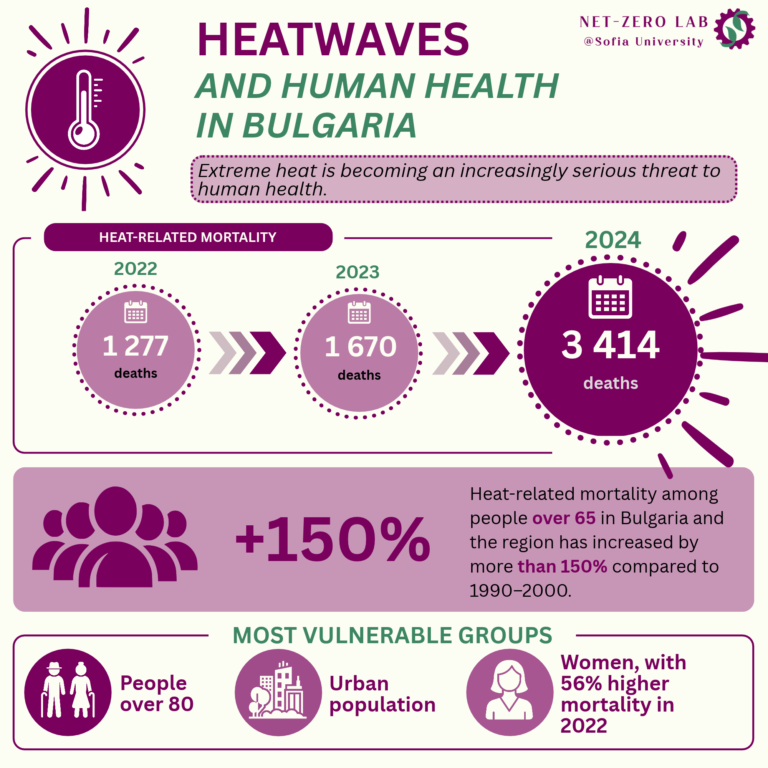
Three summers show how quickly the health burden can escalate.
European heat-mortality studies identify Bulgaria as one of the countries most affected by extreme summer temperatures.
2022
1,277
heat-related deaths
176 per million residents
2023
1,670
heat-related deaths
229 per million residents
2024
3,414
heat-related deaths
a record deadly summer for Bulgaria
2022
1,277
2023
1,670
2024
3,414
03 / VULNERABILITY IS NOT EVENLY DISTRIBUTED
Age and gender strongly shape who is most exposed.
The burden of extreme heat falls disproportionately on older people and women. Demographic ageing makes this risk especially important for Bulgaria.
AGE 65+
+150%
increase in heat-related mortality compared with 1990–2000
HIGHEST RISK
80+
older adults are among the most vulnerable groups
WOMEN
+56%
higher heat-related mortality in 2022
AGEING
Higher physiological vulnerability
→
EXTREME HEAT
Greater exposure and stress
→
HEALTH BURDEN
Higher mortality risk
04 / SOFIA AMPLIFIES THE HEAT SIGNAL
Urban form can turn hot weather into a direct mortality risk.
In Sofia, summer overheating averages around 2.5°C above background temperatures. Limited vegetation, low access to green space and the urban heat-island effect intensify exposure.
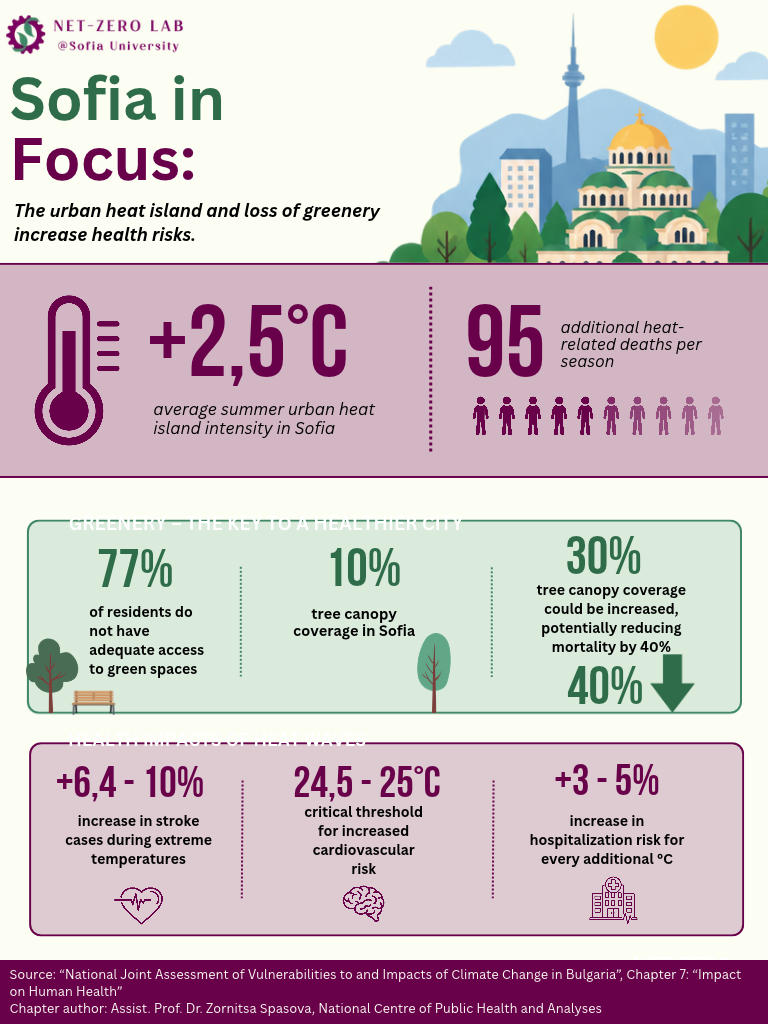
SUMMER OVERHEATING
+2.5°C
average urban overheating above background conditions
HEALTH IMPACT
95
additional deaths per summer season
GREEN ACCESS
77%
of residents lack adequate access to green space
TREE CANOPY
>10%
current canopy coverage only slightly exceeds ten percent
CITY CORE
HOTTER
GREEN SPACE
COOLER
05 / GREEN INFRASTRUCTURE IS HEALTH INFRASTRUCTURE
Trees are not only an environmental asset. They are a health intervention.
The Sofia evidence links vegetation directly with lower heat exposure and mortality. Increasing tree-canopy coverage could substantially reduce the summer health burden.
TREE-CANOPY TARGET
30%
WHO-referenced level associated with major summer-health benefits
SUMMER MORTALITY
−40%
potential reduction associated with sufficient canopy coverage
PREVENTABLE DEATHS
217–247
per year linked to insufficient vegetation
CITY CENTRE
+3–6°C
urban heat-island temperature increase
CURRENT
~10%
→
TARGET
30%
06 / TEMPERATURE RISK IS UNEQUAL
Women — especially the oldest women — show greater temperature sensitivity.
Research for Sofia shows clear differences in temperature-attributable mortality between women and men, with the oldest women facing the strongest heat effect.
WOMEN
14.4%
of deaths associated with temperature
Women 85+: heat-related mortality reaches 1.8%
MEN
9.8%
of deaths associated with temperature
Temperature-related burden remains significant but lower
Across adults in Sofia, heat itself accounts for around 1.1% of total mortality.
07 / CARDIOVASCULAR RISK HAS A TEMPERATURE THRESHOLD
Above roughly 25°C, cardiovascular risk begins to rise quickly.
Evidence for Sofia identifies a critical mean daily temperature around 24.5–25°C. Beyond this point, the health response becomes increasingly visible.
CRITICAL THRESHOLD
24.5–25°C
mean daily temperature
STROKE
+6.4–10%
increase in stroke cases during extreme temperatures
IHD HOSPITALISATION
+3–5%
for every additional degree above the critical threshold
20°C
22°C
24°C
25°C
27°C
30°C
RISK ACCELERATES →
08 / EMISSIONS PATHWAYS BECOME HEALTH OUTCOMES
By 2080, mitigation could make a fivefold difference in heat mortality.
WHO projections show sharply different outcomes for older adults depending on future emissions. The health benefit of mitigation becomes increasingly visible towards the end of the century.
LOWER EMISSIONS
<3
deaths per 100,000 people aged 65+ by 2080
VS
HIGH EMISSIONS
~15
deaths per 100,000 people aged 65+ by 2080
BASELINE
LOW
HIGH
09 / THE LATE-CENTURY GAP IS EVEN LARGER
Different emissions pathways produce radically different mortality futures.
Projected annual heat-related deaths rise under every future scenario, but the difference between moderate and high emissions becomes dramatic by 2071–2099.
2036–2064
1,150
Current
1,401
RCP4.5
2,008
RCP8.5
2071–2099
1,031
Current
1,742
RCP4.5
3,463
RCP8.5
By late century, the high-emissions projection is almost twice the RCP4.5 estimate.
10 / THE HEALTH BURDEN IS ALSO AN ECONOMIC BURDEN
Heat and pollution already impose multi-billion-leva costs.
In Sofia, the combined social and health costs associated with air pollution and thermal stress are estimated at close to BGN 5 billion annually.
SOFIA
≈ BGN 5 bn
annual social and health costs from air pollution and thermal stress
NATIONAL ECONOMY
7.8% GDP
monetised value of premature mortality
HEAT
+
AIR POLLUTION
→
HEALTH + ECONOMIC LOSS
11 / THE FUTURE HEALTH BURDEN IS NOT FIXED
Adaptation and mitigation can still change the trajectory.
Without serious adaptation, the literature points towards more frequent heat waves, greater exposure to extreme temperatures and a progressively larger mortality burden.
HEAT-WAVE DAYS — NOW
8
average days at present
BY 2050
14–18
heat-wave days per year
EXTREME YEARS
2,867
projected deaths in the hottest years when temperatures exceed 34°C
LOWER EMISSIONS
→
GREENER CITIES
→
HEAT PREPAREDNESS
→
LOWER HEALTH BURDEN
Chapter author: Chief Assist. Prof. Zornitsa Spasova, PhD, National Center of Public Health and Analyses
CONTINUE EXPLORING
 English
 Bulgarian