
Bulgaria has climate strategies in place — but implementation remains the critical test.
Mitigation reduces greenhouse-gas emissions, while adaptation addresses the immediate and long-term consequences of climate change. Effective policy requires both — integrated across institutions, sectors, regions and local government.
Climate policy has two jobs: limit future warming and prepare for impacts that are already unavoidable.
Adaptation strategies need to be dynamic, context-specific and multi-layered. Done well, they can reduce damage, strengthen resilience and limit economic losses from extreme weather.
Lower greenhouse-gas emissions and slow additional warming.
Prepare communities, infrastructure and institutions for climate impacts.
Preparation for extreme weather can prevent major social and economic damage.
The EU frames climate resilience across five interconnected policy areas.
These dimensions show why adaptation cannot be treated as a narrow environmental topic.
Protect economic activity and reduce disruption from climate shocks.
Design and upgrade infrastructure for future climate conditions.
Reduce exposure to heat, pollution and climate-sensitive disease.
Manage fiscal, insurance and investment risks linked to climate impacts.
Coordinate institutions, responsibilities, data and preparedness.
The formal framework has expanded, but implementation remains uneven.
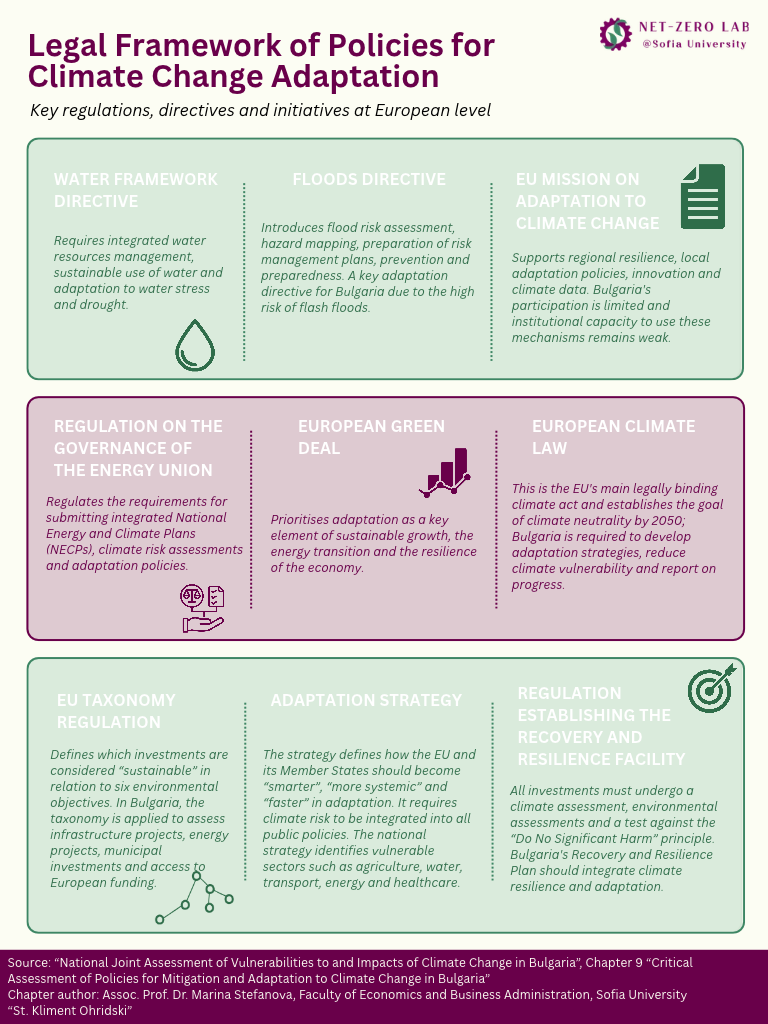
Over the last decade Bulgaria has institutionalised several key climate instruments. They broadly follow the European Green Deal and the EU Climate Law, but remain constrained by governance, financing and implementation gaps at national and municipal level.
Framework for integrating climate risks into sectoral policy.
Long-horizon decarbonisation framework.
National pathway for meeting EU energy and climate objectives.
Core national legislative framework.
EU climate objectives provide the strategic direction; national legislation and planning instruments determine implementation in Bulgaria.
Formal alignment with EU climate policy has not always translated into rapid implementation.
Bulgaria maintained a reserved position toward stronger decarbonisation targets, coal closures and a faster energy transition. At the final Council vote on the European Climate Law in June 2021, Bulgaria was the only member state to abstain.
Formal compliance can coexist with slow reform, delayed legislation and fragmented administrative capacity.
Delayed reforms exposed weaknesses in coordination and administrative capacity.
Bulgaria adopted its National Recovery and Resilience Plan later than other member states and subsequently had to revise projects and timelines. Political instability, repeated elections, delayed laws and fragmented administrative capacity slowed implementation.
Frequent political change slowed reform continuity.
Required legal changes were not always delivered on time.
Administrative responsibilities and expertise remain dispersed.
Adaptation has been less integrated than decarbonisation.
Experts and civil-society organisations have criticised an “administrative compliance” approach to climate assessment and the limited use of long-term climate scenarios.
The largest weakness is the absence of integrated climate governance.
Adaptation is still too often treated as an environmental issue rather than as regional security policy, economic policy, health policy and a driver of infrastructure change.
Climate resilience is treated as part of strategic autonomy, economic stability and long-term risk management.
Requirements are often met at compliance level without sufficient integration into territorial planning, infrastructure and local governance.
Stronger adaptation requires clearer mandates, local capacity and enforceable climate-risk assessment.
The chapter proposes governance reforms that move adaptation from voluntary or project-based action toward permanent institutional responsibility.
Define institutional duties, sectoral adaptation goals, mandatory risk assessments, accountability and sanctions.
Use standardised methodologies and regional climate centres for technical support.
Provide public data access and automated warning systems.
Create a national climate fund and gradually introduce climate budgeting.
Water security and climate-resilient agriculture need to become core adaptation priorities.
Existing water infrastructure was designed for twentieth-century climate conditions, not today’s more extreme variability.
Upgrade critical systems and reduce leakage in water networks.
Use water more efficiently under conditions of scarcity.
Use incentives for crop choice, agroforestry and soil restoration.
Reduce water demand and improve resilience of production.
Support faster response to drought and other climate stresses.
Urban adaptation must address heat, health and the built environment together.
Reducing urban heat-island effects requires mandatory green space, large-scale urban tree planting, cooling infrastructure and limits on overdevelopment.
Expand green areas and large-scale tree planting.
Design public space and buildings for heat resilience.
Create operational plans for heatwaves and vulnerable groups.
Strengthen health surveillance linked to climate risks.
Effective climate policy depends on turning formal commitments into integrated, measurable implementation.
Bulgaria already has many of the strategic building blocks. The next step is to connect them through stronger institutions, climate-proof infrastructure, better local capacity, public data, dedicated financing and systematic climate education.
Climate resilience becomes effective when it is embedded in everyday decisions across government, infrastructure, health, finance and local planning.
Chapter author: Assoc. Prof. Dr. Marina Stefanova, Faculty of Economics and Business Administration, Sofia University “St. Kliment Ohridski”.
 English
 Bulgarian