
REGIONAL FOCUS · DOBRUDZHA
Bulgaria’s breadbasket is becoming a frontline of climate risk.
Dobrudzha has long been central to Bulgaria’s food security and agricultural exports. Its exceptionally fertile chernozem soils support intensive farming, yet growing climate variability, summer heat and soil-moisture deficits are making the region increasingly vulnerable.
SCROLL TO EXPLORE ↓
01 / A STRATEGIC AGRICULTURAL REGION
Dobrudzha sits at the intersection of food security and climate exposure.
Traditionally described as Bulgaria’s breadbasket, the region occupies a strategic place in national grain production and agricultural exports. Its productivity is built on fertile chernozem soils and a long history of intensive conventional agriculture.
ROLE
National food security
A major production base for Bulgaria’s cereal agriculture.
RESOURCE
Chernozem soils
Exceptionally fertile soils historically supporting intensive farming.
RISK
Climate volatility
Heat, rainfall irregularity and moisture deficits increasingly overlap.
02 / THE CLIMATE SIGNAL IS VARIABILITY
The dominant signal is not smooth warming. It is growing unpredictability.
ERA5-Land analysis for the critical April–August growing season shows sharp year-to-year variability rather than a simple linear warming trajectory. The agricultural risk lies in increasingly frequent local anomalies where intense heat waves coincide with prolonged dry periods.
PERIOD ANALYSED
2000–2024
Spring–summer climatic conditions
GROWING SEASON
Apr–Aug
Critical period for regional agriculture
MANN–KENDALL
p = 0.18
No simple linear warming trajectory
Bars: Total Precipitation (Apr–Aug) · Line: Average Temperature (Apr–Aug)
03 / THE WINTER RECHARGE MECHANISM
Summer resilience begins months before the growing season.
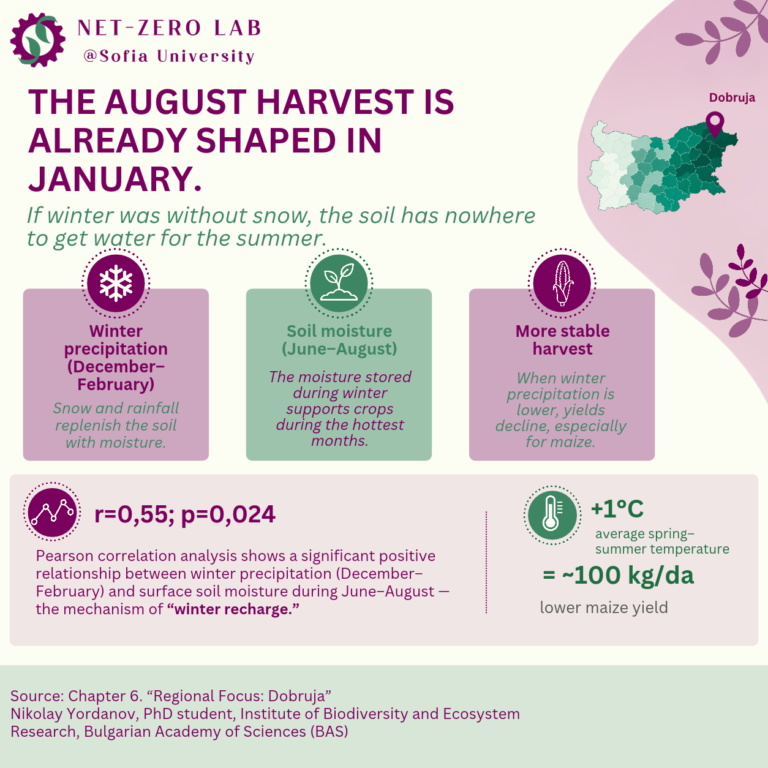
A statistically significant relationship links cumulative winter precipitation with moisture retained in the upper soil layer during the following summer. This delayed effect makes winter precipitation a critical hydrological buffer.
PEARSON CORRELATION
r = 0.55
p = 0.024
DEC–FEB
Winter precipitation
→
LAG EFFECT
Soil recharge
→
JUN–AUG
Summer soil moisture
Less stable snow cover and fewer prolonged winter precipitation events weaken the soil’s ability to buffer crops against summer heat.
04 / CLIMATE STRESS BECOMES YIELD LOSS
Extreme years reveal how exposed conventional production has become.
Regional yield data for 2010–2024 shows a significant positive relationship between April–August precipitation and maize yields. The effect becomes especially clear in years of severe drought and heat.
2020
Severe drought
WHEAT
178
kg/da
MAIZE
255
kg/da
2024
Moist winter, extreme summer
WHEAT
652
kg/da
MAIZE
221
kg/da
In 2024 maize yield was approximately 70% below its optimal potential because of extreme summer heat and moisture deficit.
05 / RAINFALL AND MAIZE MOVE TOGETHER
Spring–summer precipitation is strongly connected to maize productivity.
PEARSON
r = 0.55
SIGNIFICANCE
p = 0.03
Relationship between Spring/Summer Rainfall and Maize Yields
06 / HEAT MULTIPLIES THE RISK
Higher temperatures do not simply accompany drought. They intensify its impact.
Multiple linear regression identifies temperature as a critical negative multiplier for maize production.
SPRING–SUMMER TEMPERATURE
+1 °C
→
APPROXIMATE MAIZE YIELD CHANGE
−100
kg/da
TEMPERATURE EFFECT
p = 0.026
07 / NOT ALL CROPS CARRY THE SAME RISK
Maize is substantially more volatile than winter wheat.
The coefficient of variation provides a simple measure of production instability. Regional data places maize in a significantly higher-risk category under current climate trajectories.
WINTER WHEAT
22.39%
coefficient of variation
MAIZE
34.54%
coefficient of variation
Under current climate trajectories, maize emerges as the higher-risk crop.
08 / RESTORING THE LANDSCAPE BUFFER
Resilience begins beyond the field boundary.
One strategic priority is the large-scale rehabilitation of Dobrudzha’s historical shelterbelt network. Green infrastructure can reduce wind erosion, lower surface temperatures and limit evaporation from agricultural soils.
09 / CONSERVATION AGRICULTURE
Soil itself must become part of the climate adaptation strategy.
Stable institutional support for conservation agriculture can improve soil structure, retain organic carbon and increase water-holding capacity.
PRACTICE
No-till
Minimal soil disturbance.
PRACTICE
Strip-till
Targeted cultivation with greater soil protection.
OUTCOME
More water retained
Improved hydrological resilience of agricultural soils.
ORGANIC CARBON
→
SOIL STRUCTURE
→
WATER STORAGE
→
RESILIENCE
10 / ENERGY WITHOUT DISPLACING FOOD
Dobrudzha’s energy potential is an opportunity — if land competition is avoided.
The region has Bulgaria’s strongest wind-energy potential, creating a strategic opportunity for decarbonisation. Energy development, however, must protect high-quality agricultural land.
AGRICULTURE
Productive land
Preserve high-value arable soils.
+
CLEAN ENERGY
Wind & solar
Use regional renewable-energy potential.
=
STRATEGY
Agro-energy synergy
Integrate renewable energy without displacing food production.
11 / FROM VULNERABILITY TO RESILIENCE
Dobrudzha can become a model for climate-resilient regional development.
The region’s future depends on combining agricultural adaptation with protection of soil hydrology, carbon stocks and productive land while diversifying the regional economy.
RESTORE
Shelterbelts
+
PROTECT
Soil moisture
+
TRANSFORM
Farming systems
+
INTEGRATE
Clean energy
FROM
Climate vulnerability
→
TO
Regional resilience
Chapter author: Chief Assist. Prof. Zornitsa Spasova, PhD, National Center of Public Health and Analyses
CONTINUE EXPLORING
 English
 Bulgarian