
BIODIVERSITY & ECOSYSTEMS
Climate change is transforming Bulgaria’s forests, species and ecosystems.
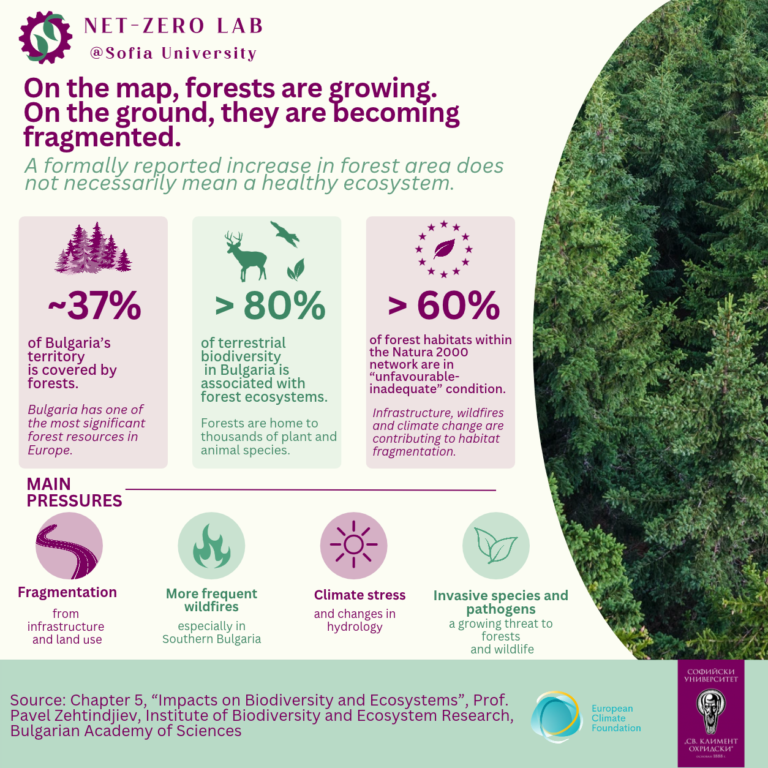
Forest cover can appear stable while ecological health declines. Fires, drought, habitat fragmentation, shifting species ranges, changing migration patterns and emerging pathogens are reshaping Bulgaria’s natural systems.
SCROLL TO EXPLORE ↓
01 / A BIODIVERSITY STRONGHOLD
Bulgaria’s forests support an extraordinary share of terrestrial life.
Bulgaria forms part of the Balkan biodiversity complex and contains one of Europe’s significant forest resources. These ecosystems provide critical ecological functions and support a large share of the country’s terrestrial biodiversity.
of Bulgaria’s territory
supported by forest ecosystems
services for nature and society
02 / MORE FOREST DOES NOT ALWAYS MEAN HEALTHIER FOREST
A nominal increase in forest area can hide deeper ecological decline.
CORINE Land Cover data for 2000–2024 shows a transition from abandoned pastures toward broadleaf woodland through secondary succession. Formally, this increases reported forest area — but these newly wooded areas do not necessarily perform the ecological functions of established forests.
At the same time, lowland and riparian forests are increasingly fragmented by infrastructure expansion.
03 / NATURA 2000 UNDER PRESSURE
Protected status does not automatically mean favourable ecological condition.
More than 60% of forest habitats within Bulgaria’s Natura 2000 network are assessed as being in an unfavourable–inadequate condition, linked to altered hydrology and intensive use.
in an unfavourable–inadequate condition
04 / FIRE AS AN ECOSYSTEM SHOCK
More intense forest fires can erase years of ecological recovery in a single season.
Southern Bulgaria — including the Rhodopes and Sakar — lies in an area of particularly high fire risk. Fires affect not only vegetation but entire animal populations and reproductive cycles.
Fires cause major mortality in Testudo graeca and Testudo hermanni.
Populations may require decades to recover.
Entire generations can be lost during the reproductive period.
05 / SPECIES ARE MOVING
Climate change is redrawing the biological boundaries of Bulgaria.
Several characteristic species are shifting toward higher elevations as temperature and moisture conditions change.
06 / WINTER IS MOVING NORTH
Warmer, snow-free winters are shifting wintering grounds away from Bulgaria.
Bulgaria has historically been important for wintering geese, including the globally threatened red-breasted goose. Warming conditions are associated with a northward and north-westward shift in wintering areas.
Wintering goose populations in north-eastern Bulgaria decline as January temperatures rise. The charts below show the long-term relationship between warmer winters and decreasing wintering numbers.
Source: Institute of Biodiversity and Ecosystem Research – Bulgarian Academy of Sciences, long-term monitoring of wintering goose populations.
07 / MIGRATION STRATEGIES ARE CHANGING
Birds are changing how they cross northeastern Bulgaria.
Reduced surface water and stronger warming of the land surface are associated with higher flight altitudes and longer transit distances for soaring migratory birds such as storks and pelicans.
As a result, parts of northeastern Bulgaria increasingly lack the traditional autumn flocks of storks once associated with the region.
08 / NATURE’S CLOCK IS SHIFTING
When one species changes timing, entire ecological relationships can fall out of sync.
In Strandzha, oak trees are leafing earlier. This creates a mismatch between vegetation, insect cycles and migratory birds moving along Via Pontica.
days earlier
09 / INVASIVE SPECIES & PATHOGENS
A warmer climate can expand the ecological space available to new pathogens.
Long-term research by the Institute of Biodiversity and Ecosystem Research indicates that climatic warming can create conditions for numerous pathogens dangerous to animal species and humans.
dangerous to animal species and humans
increase in spread rate
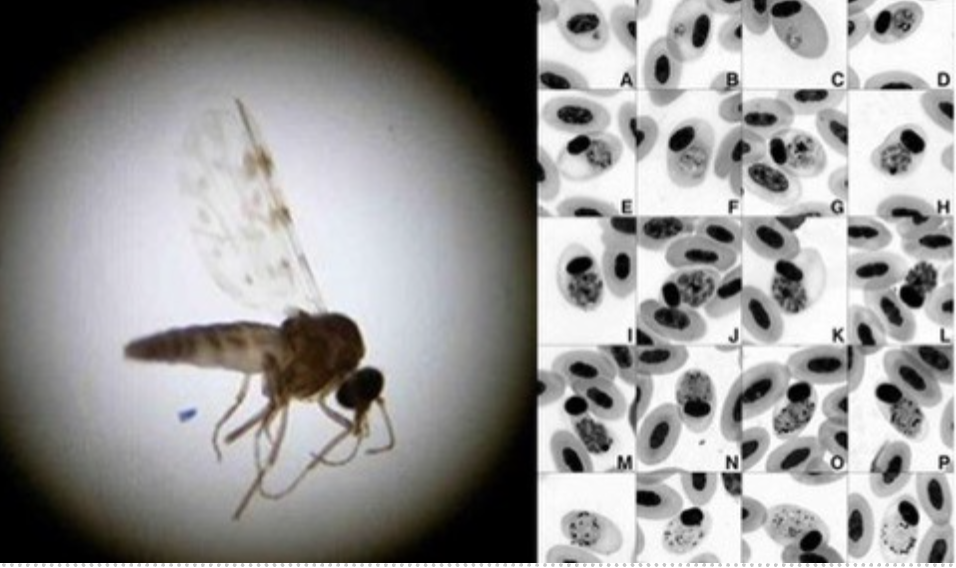
Long-term research on blood parasites in birds and the potential expansion of pathogens under warmer climatic conditions.
Source: Institute of Biodiversity and Ecosystem Research – Bulgarian Academy of Sciences.
10 / THE BIGGER PICTURE
Spatial stability does not necessarily mean ecological health.
Bulgaria’s forests are entering a period of transformation. Climate stress, habitat fragmentation, fire, altered species behaviour and new pathogens can progress even where total forest area appears stable.
Ecosystem-level changes affect not only biodiversity but also economic activity and human health.
Chapter author: Prof. Pavel Zehtindzhiev, PhD, Institute of Biodiversity and Ecosystem Research – Bulgarian Academy of Sciences (BAS)
CONTINUE EXPLORING
 English
 Bulgarian